

Key Takeaways
- High-quality mental health care depends not only on the clinician, but also on the organization supporting that clinician.
- Dr. Stacey Krauss's 10 years as an active-duty U.S. Army psychologist shaped how she thinks about making mental health care safe, practical and easier to access.
- Strong healthcare organizations should be willing to learn, receive feedback, measure what matters and continuously improve.
- Leadership often requires taking action before you feel completely prepared, a lesson Dr. Krauss applies to both professional growth and organizational leadership.
- Transitions Counseling and Consulting is designed to give children, teens and adults access to multiple forms of outpatient mental health care within one organization.
Listen to Dr. Stacey Krauss's full High Velocity Radio interview:
Listen to the podcast
What makes mental health care truly good?
The obvious answer is having an excellent therapist, psychologist or psychiatric provider. But the quality of someone's care is also influenced by many things that happen outside of the therapy room: how difficult it is to get an appointment, whether providers communicate, whether the organization learns from patient feedback, how clinicians are trained, and whether someone can access a different level of support when their needs change.
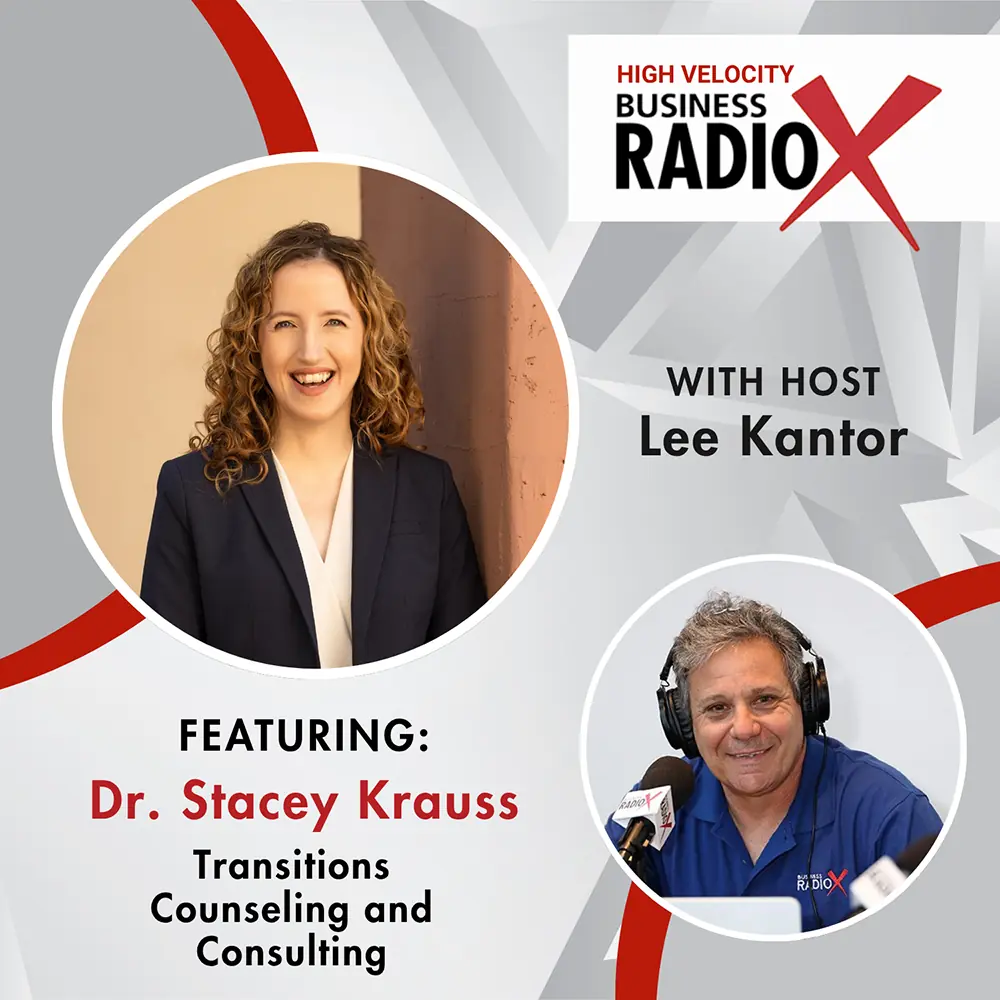
Dr. Stacey Krauss, Psy.D., ABPP, CEO of Transitions Counseling and Consulting, recently joined Lee Kantor on High Velocity Radio for a conversation about that less visible side of mental health care.
The episode, "Building High-Performing Teams Through Coachability, Data, and Continuous Growth," explores Dr. Krauss's path from active-duty Army psychologist to healthcare CEO, along with the leadership philosophy she has brought to Transitions Counseling and Consulting. The conversation covers accessible mental health care, leadership, imposter syndrome, coachability, measurement and why organizations responsible for caring for people should never stop learning.
Better Mental Health Care Starts With the Organization Behind the Therapist
Dr. Krauss originally expected her career in psychology to focus primarily on providing therapy directly to families. Her time in the Army led her in a different direction.
She discovered that some of the work she found most meaningful involved building the organizations in which care takes place.
There is tremendous value in helping one person during one therapy hour, as Dr. Krauss explains in the interview. But there is another way to create an impact: build an organization that allows many therapists and mental health professionals to provide excellent care to many more people.
That requires thinking beyond clinical technique. It means asking questions about access, training, compliance, coordination, leadership, quality and the overall experience of the people receiving care.
The challenge, as Dr. Krauss describes it, is creating systems that meet the complex safety, legal and ethical requirements of healthcare while allowing the patient's experience to remain deeply human and empathetic.
What the U.S. Army Taught Dr. Krauss About Mental Health Care
Dr. Krauss spent the first 10 years of her career on active duty as a psychologist in the U.S. Army.
Her path into military psychology began unexpectedly. While attending college on an Army ROTC scholarship, she met an active-duty Army psychologist and realized that psychology and military service could be combined into a single career.
That experience eventually placed her in significant leadership roles early in her career. As Dr. Krauss recalls in the podcast, she finished her psychology internship on a Friday and began serving as a chief of psychology the following Monday.
The transition forced her to learn quickly.
She had to understand not only clinical psychology, but how to lead healthcare professionals, navigate extensive rules and regulations, and build systems that allowed clinicians to do their jobs effectively while keeping patients safe.
Those lessons continue to influence how she approaches Transitions today.
The underlying question is simple: How do you build mental health care around the people who actually need to use it?
Why Access to Mental Health Care Has to Be Practical
During the podcast, Dr. Krauss describes Transitions' goal as becoming a place where families can access their outpatient mental health needs without having to navigate an entirely separate organization for each problem.
Transitions works with children, teenagers and adults and offers multiple forms of outpatient care across Arizona and Texas. That includes individual therapy, psychiatry and medication management, as well as more structured outpatient programs for people who need additional support.
Learn more about Transitions’ individual counseling and therapy, psychiatry and medication management and intensive outpatient programs.
The idea is not that every person needs every service.
It is that mental health needs can change.
One family might have a teenager who needs therapy while a parent needs psychiatric care. Someone receiving weekly therapy may later need more structured treatment. Another patient may improve and transition back to less intensive support.
When those services are disconnected, patients and families may have to repeatedly search for new providers, transfer records and explain their situation all over again.
Good healthcare design should reduce those barriers rather than create more of them.
What Does Imposter Syndrome Have to Do With Leadership?
One of the most personal parts of Dr. Krauss's conversation with Lee Kantor focuses on imposter syndrome.
Her Army career repeatedly placed her into positions of responsibility before she necessarily felt completely prepared for them.
Her advice is applicable well beyond healthcare:
Action comes first. The feeling often comes second.
Dr. Krauss compares it to going to the gym. If you wait until you feel completely motivated before going, you may never get there. But after taking the action, the feeling often changes.
She describes imposter syndrome in a similar way. Waiting until you feel like you completely belong in a job, profession or leadership position can keep you from taking the actions that eventually create that confidence.
That lesson matters in a healthcare organization too.
Teams cannot improve if everyone waits until they have a perfect answer. Leaders have to be willing to act, learn from what happens, adjust and keep moving forward.
Why Coachability Matters in Mental Health Care
The High Velocity Radio conversation also explores coachability and continuous growth, principles that are reflected in how Transitions describes its organizational culture.
Mental health is a profession built around helping people change, learn and develop new skills. A mental health organization should expect the same from itself.
Being coachable means being willing to receive feedback without treating feedback as failure. It means clinicians, managers and leaders can continue learning even after years of professional training.
For patients, that culture matters.
Mental health care should not operate under the assumption that once a treatment process or organizational system has been created, it can never get better. Providers learn. Research evolves. Patients provide feedback. Teams discover better ways to communicate and coordinate care.
An organization committed to continuous improvement should be able to take what it learns and use it to improve the next person's experience.
Why Mental Health Organizations Should Measure What Matters
Dr. Krauss's professional interests include the use of data to support strong treatment outcomes, and measurement is another important theme in her High Velocity Radio conversation.
Healthcare is intensely human, but that does not mean organizations should rely only on intuition.
Patient feedback, treatment outcomes, access to appointments, safety measures and other data can help a mental health organization understand whether its systems are actually working.
The purpose of measurement is not to reduce a person's mental health journey to a number. It is to identify patterns that individual clinicians or leaders might otherwise miss.
Are patients receiving care quickly enough? Do people feel supported by the organization? Are programs helping people make meaningful progress? Where are patients encountering unnecessary barriers?
Data can help teams ask better questions. It can also make it harder for an organization to assume that something is working simply because it has always been done that way.
At Transitions, that philosophy is reflected in one of the organization's stated values: Measure What Matters. Its other published values include Take Action and Coach and Be Coachable, themes that closely mirror Dr. Krauss's discussion on the podcast.
What Should Families Look for in a Mental Health Organization?
Finding the right individual provider is important, but families can also look at the broader organization supporting that provider.
Useful questions include:
- Does the organization provide evidence-based treatment?
- Are clinicians appropriately licensed and trained?
- Does the organization have systems for quality and patient safety?
- Can care change if someone's needs become more or less intensive?
- Does the practice gather feedback and evaluate the quality of the care it provides?
- Are therapy, psychiatry and other services coordinated when someone needs more than one kind of support?
- Is getting started reasonably straightforward?
These questions become particularly important when a child, teenager or adult needs ongoing care rather than a single appointment.
The strongest mental health organizations should combine good clinical care with systems that make that care easier to access and navigate.
Can One Mental Health Organization Care for an Entire Family?
It can, depending on the services offered and the individual needs of family members.
Dr. Krauss explains in the podcast that Transitions was intentionally built to provide outpatient mental health care across the lifespan. Children, teenagers and adults can receive care within the same organization, although each person's treatment remains individualized.
This can be especially helpful because mental health rarely exists in isolation.
A teenager experiencing significant anxiety can affect the whole family. A parent's depression can influence relationships at home. A major life transition may create different mental health needs for different people living under the same roof.
Families do not necessarily need the same treatment, but having access to a coordinated mental health system can make navigating those needs simpler.
What Makes a Mental Health Organization High Quality?
There is no single metric that answers this question.
Quality mental health care involves the clinicians themselves, but also the systems surrounding them. Evidence-based treatment, appropriate training, patient safety, accessibility, communication, coordination, measurement and a willingness to keep improving all play a role.
That is one reason Dr. Krauss's background is unusual.
She brings together clinical psychology, organizational psychology, healthcare leadership and a decade of experience inside one of the country's largest and most complex organizations, the U.S. Army.
Her work at Transitions applies those lessons to a different mission: building a mental health organization capable of helping children, teenagers, adults and families receive the right care without making an already difficult moment more complicated.
Frequently Asked Questions
What is organizational psychology?
Organizational psychology applies psychological principles to workplaces, leadership, teams and organizations. It can involve areas such as employee development, leadership, culture, decision-making, performance and organizational effectiveness.
Dr. Krauss is board certified in both Clinical Psychology and Business and Organizational Consulting Psychology, giving her experience in both individual mental health care and the systems in which that care is delivered.
How does leadership affect patient care?
Leadership influences how healthcare organizations hire and train clinicians, maintain quality and safety standards, respond to feedback, coordinate services and improve systems. Patients may never see much of this work directly, but it can significantly influence their experience receiving care.
Why does Transitions measure patient feedback and outcomes?
Measurement can help a mental health organization identify what is working and where care or operations can improve. Patient experience and clinical information can provide insights that are difficult to identify through intuition alone.
What does “coach and be coachable” mean?
It means helping others improve while remaining willing to receive feedback and change yourself. In a healthcare setting, coachability supports continued professional development and helps teams learn from patients, colleagues and outcomes.
Does Transitions provide mental health care for the whole family?
Transitions Counseling and Consulting provides outpatient mental health services for children, teenagers and adults in Arizona and Texas. Available services include individual counseling, psychiatry and medication management, structured outpatient treatment and telehealth, depending on location and individual needs.
Listen to Dr. Stacey Krauss on High Velocity Radio
The full High Velocity Radio conversation goes deeper into Dr. Krauss's path from Army psychologist to CEO, the leadership lessons she learned along the way, and how coachability, measurement and continuous learning shape the organization she leads today.
Listen to the full interview with Dr. Stacey Krauss
About Dr. Stacey Krauss
Stacey Krauss, Psy.D., ABPP, is CEO of Transitions Counseling and Consulting. She served for 10 years as an active-duty U.S. Army psychologist and is board certified in both Clinical Psychology and Business and Organizational Consulting Psychology.
Learn more about Dr. Stacey Krauss and her background.
Her professional experience includes leading multidisciplinary behavioral health teams, developing clinician training programs and using data to support better treatment outcomes.
Today, she leads Transitions Counseling and Consulting's work to provide accessible mental health care for children, teenagers, adults and families throughout Arizona and Texas.
Find Mental Health Support for Your Family
Transitions Counseling and Consulting offers mental health services for children, teens, adults, couples and families in Arizona and Texas, with telehealth available when appropriate. Contact Transitions or call (602) 363-0629 to schedule an appointment or ask which services fit your needs.
