
Transitions Counseling provides a daytime partial hospitalization program (PHP) for adolescents who need more than weekly therapy without an overnight hospital stay. The Phoenix-based teen PHP combines group therapy, individual psychiatry support, family sessions, and school coordination Monday–Friday, with teens returning home each evening.
Service area includes Phoenix (Arcadia, Biltmore, Central/North Phoenix, Ahwatukee, Desert Ridge) and nearby Scottsdale, Tempe, Glendale, and Paradise Valley. For fit and benefits verification, call 602-363-0629.

When your child needs more than weekly therapy—but not an overnight hospital stay—our Partial Hospitalization Program (PHP) delivers intensive, structured care while keeping them connected to home, school, and community. At Transitions Counseling in Phoenix, we’ve built a day-program that blends evidence-based therapy, psychiatric care, and real-world practice so teens can stabilize, build skills, and return to life with confidence.
PHP offers the therapeutic depth of inpatient care with the flexibility of evenings at home. Families in Phoenix choose Transitions because our program is:
Our PHP for teens includes:
If you’re unsure whether PHP or IOP is the right fit, we’ll help you determine the most appropriate level of care.
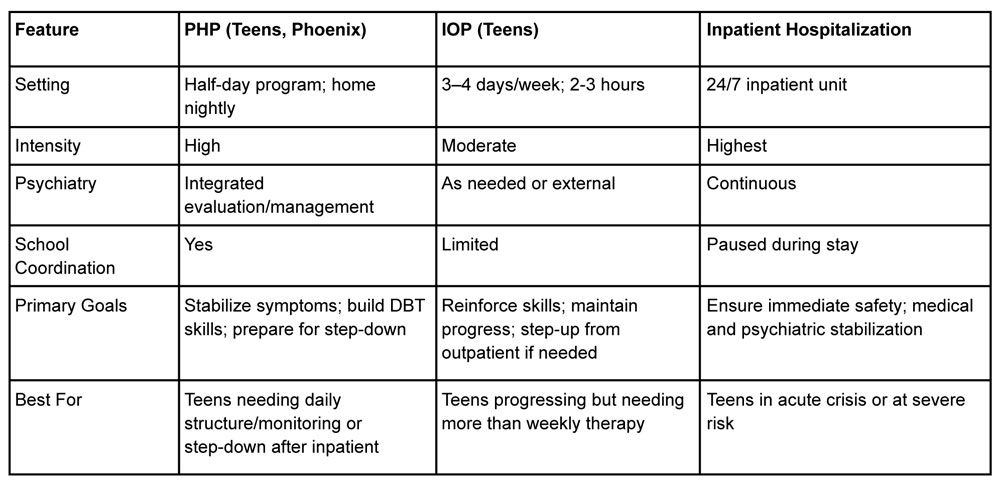
The levels of care differ in setting, intensity, and goals. Use the table below to compare options available to families:
Discharge planning begins at admission. Many adolescents benefit from transitioning to an intensive outpatient program, moving from 20 hours of supportive care per week to 6-8 hours per week. This helps to gradually and planfully reduce the amount of weekly support as a teen returns to full-time schooling and other responsibilities. Following the completion of an intensive outpatient program, many clients benefit from routine therapy and psychiatry to help sustain symptom reduction and to practice coping skills over time.Discharge planning begins at admission. Many adolescents benefit from transitioning to an intensive outpatient program, moving from 20 hours of supportive care per week to 6-8 hours per week. This helps to gradually and planfully reduce the amount of weekly support as a teen returns to full-time schooling and other responsibilities. Following the completion of an intensive outpatient program, many clients benefit from routine therapy and psychiatry to help sustain symptom reduction and to practice coping skills over time.
You don’t have to navigate this alone. Let’s talk through your teen’s needs and whether PHP is the right level of care.
Call us at 602-363-0629 or reach out through our contact form to schedule a confidential consultation. A more stable, connected future can start today—right here in Phoenix.
Length varies by clinical need; many adolescents complete 6 weeks of programming with a planned step-down to IOP followed by outpatient therapy.
Transitions Counseling and Consulting is in network with many plans for this service and verifies benefits prior to enrollment and explains any out-of-pocket costs.
Programming runs Monday–Friday from 1pm-5pm, allowing teens to return home nightly to
practice skills with family support.
Yes. PHP commonly serves as a step-down level of care to restore routine while maintaining daily therapeutic structure and psychiatry oversight.
Yes. With caregiver consent, the Phoenix team coordinates with schools to reduce academic disruption and plan a supported return.
Safety planning is developed with caregivers; crisis resources are provided. For acute risk, inpatient care may be recommended.