
Teen Intensive Outpatient Program (IOP) in Arizona & Texas
When your teenager is struggling with their mental health, it can be difficult to know what level of support they need. Weekly therapy may no longer feel like enough, but inpatient treatment may seem too intensive.
A Teen Intensive Outpatient Program (IOP) offers a middle ground by providing structured, evidence-based treatment while allowing teens to continue living at home, attending school, and staying connected with family.
At Transitions Counseling and Consulting, our teen intensive outpatient program helps adolescents develop healthier coping skills, strengthen emotional regulation, improve communication, and build confidence in a supportive environment alongside peers facing similar challenges.
Because we provide a full continuum of outpatient mental health services, teens can continue working with the same trusted team if their treatment needs change over time.
Whether your child is stepping up from weekly therapy or stepping down from a higher level of care, we’ll help determine the treatment plan that best supports their recovery

Teen IOP at a glance
Who It's For
Teens ages 13–17 who need more support than weekly therapy
Schedule
2–3 days per week for 2–3 hours per session
Program Length
Most teens participate for 8-12 weeks, depending on individual progress
Parent Involvement
Weekly parent support groups, family communication, and professionally developed workbooks to reinforce skills at home.
School-Friendly Scheduling
Evening and virtual options are available at select locations
Insurance
We accept most major insurance plans and verify benefits before treatment begins
Locations
Arizona & Texas
Getting Started
Begin with a confidential assessment to determine whether Teen IOP is the right level of care
Who does teen IOP serve?
A teen intensive outpatient program is designed for adolescents ages 13–17 who need more support than traditional weekly therapy but do not require inpatient hospitalization or a Partial Hospitalization Program (PHP).
Many families begin considering Teen IOP after noticing that their child’s emotional or behavioral challenges are becoming more difficult to manage at home, at school, or in relationships.
Sometimes a pediatrician, therapist, psychiatrist, or school counselor recommends a higher level of care after recognizing that additional structure may help.
Teen IOP may be appropriate for adolescents experiencing:
- Anxiety disorders
- Depression
- Trauma or PTSD
- ADHD
- Emotional regulation difficulties
- School avoidance
- Social withdrawal
- Family conflict
- Relationship challenges
- Low self-esteem
- Increased stress or overwhelm
- Difficulty coping with significant life changes
For many adolescents, an intensive outpatient program provides meaningful support while allowing them to remain engaged in school, family life, and their community.
Before recommending Teen IOP, our clinical team completes a comprehensive assessment to better understand your teenager’s symptoms, strengths, goals, and current level of functioning.
If another level of care would better meet their needs, we’ll explain those recommendations and help your family determine the most appropriate next step.
Many parents tell us they simply want to know they’re making the right decision for their child. Our goal is to help families feel informed, supported, and confident throughout every stage of treatment.
What a day in Teen IOP looks like
One of the most common questions parents ask is, “What will my teenager actually do during the program?”
While every treatment plan is individualized, Teen IOP follows a structured schedule designed to help adolescents develop practical coping skills while continuing to attend school, participate in family life, and maintain their daily routines.
Most Teen IOP groups meet two to three days each week for approximately two to three hours per session. Many locations offer afternoon, evening, or virtual options to help treatment fit around school schedules, extracurricular activities, and family commitments.
A typical Teen IOP session may include:
Group therapy
Group therapy serves as the foundation of Teen IOP. Led by licensed mental health professionals, sessions provide a supportive environment where teens can discuss challenges, practice new coping strategies, and learn from peers experiencing similar struggles.
According to the American Psychological Association, group therapy helps participants improve interpersonal skills, strengthen relationships, and benefit from shared experiences and mutual support.
Many teens begin the program feeling nervous about participating in a group. Over time, they often discover they’re not alone in what they’re experiencing, which can help reduce feelings of isolation while building confidence and resilience.
Skills-building activities
Every session includes practical skill development that teens can begin applying immediately in everyday life.
Common topics include:
- Managing anxiety and overwhelming emotions
- Healthy coping strategies
- Emotional regulation
- Communication skills
- Problem-solving
- Conflict resolution
- Building self-esteem
- Stress management
Many of these skills are taught using evidence-based approaches such as Dialectical Behavior Therapy (DBT) and Cognitive Behavioral Therapy (CBT), giving teens practical tools they can continue using long after treatment ends.
Individual clinical support
Although Teen IOP is primarily group-based, every participant also receives individual clinical support throughout treatment.
Brief one-on-one check-ins allow therapists to monitor progress, discuss challenges, review treatment goals, and make adjustments when needed. These conversations also help ensure that every teen receives personalized attention in addition to the benefits of group therapy.
Ongoing assessment
Progress is monitored throughout treatment using evidence-based assessments, clinical observations, and regular communication with both teens and parents.
This allows the treatment team to evaluate what’s working, identify areas needing additional support, and adjust treatment recommendations as progress is made.
How parents are included in a Teen IOP
Parents and caregivers are essential to a teenager’s recovery. While Teen IOP encourages adolescents to build independence and confidence, treatment is most successful when families actively participate in the process.
Rather than simply dropping off and picking up your teen, you’ll become an important member of the treatment team.
Depending on your teenager’s needs, parental involvement may include:
- Regular communication with clinicians
- Updates on treatment goals and progress
- Family therapy sessions, when appropriate
- Parent support groups
- Guidance for reinforcing healthy coping strategies outside of treatment
These conversations give parents opportunities to ask questions, discuss concerns, celebrate progress, and better understand what their teen is learning during treatment.
Our goal is not only to help adolescents develop healthier coping skills but also to provide parents with practical tools that strengthen communication, improve family relationships, and create a more supportive home environment.
Many families find that the positive changes extend beyond the individual teen, leading to healthier communication and stronger relationships throughout the household.
How Teen IOP differs from Adult IOP
Teen and adult intensive outpatient programs share many evidence-based treatment approaches, but they are designed to address different stages of life and development.
Teen IOP focuses on helping adolescents manage the unique emotional, social, academic, and family challenges of adolescence. Treatment emphasizes age-appropriate skill development while recognizing that parents and caregivers play an important role in long-term success.
Teen IOP commonly focuses on:
- Emotional regulation
- Building healthy peer relationships
- Managing academic stress
- Strengthening family communication
- Developing confidence and resilience
- Learning healthy coping strategies
Parents remain actively involved throughout treatment because family support is often one of the strongest predictors of lasting progress.
Adult IOP, while similar in structure, focuses more heavily on workplace stress, independent living, parenting, relationships, and other responsibilities unique to adulthood.
Why choose a teen IOP?
A teen intensive outpatient program offers more than additional therapy sessions—it provides the structure, consistency, and support many adolescents need to make meaningful progress while continuing to live at home and attend school.
For families who feel weekly counseling is no longer enough. Still, inpatient treatment isn’t necessary. Teen IOP bridges that gap with evidence-based care, regular clinical support, and opportunities to practice new skills in real-life situations.
Comprehensive, coordinated care
Mental health challenges often affect every part of a teenager’s life, from school performance and friendships to family relationships and self-confidence. That’s why our clinical team works together to provide coordinated care rather than treating concerns in isolation.
Therapists, psychiatrists, and other providers collaborate throughout treatment, helping ensure your teen receives personalized recommendations that evolve as progress is made.
Because multiple levels of care are available within Transitions Counseling and Consulting, families can often continue working with the same team if treatment needs change over time.
Real-life skill development
The goal of Teen IOP isn’t simply to help teens feel better during treatment—it’s to help them build skills they can continue using long after the program ends.
Throughout treatment, adolescents learn healthier ways to manage emotions, communicate effectively, respond to stress, and navigate challenges at school, home, and in relationships.
As they begin applying these strategies between sessions, many families notice increased confidence, stronger coping skills, and meaningful improvements in everyday life
The power of peer connection
Adolescence can feel isolating, especially when a teen is struggling with anxiety, depression, trauma, or overwhelming stress. Teen IOP allows adolescents to connect with peers who understand what they’re experiencing in a safe, professionally facilitated environment.
Sharing experiences, celebrating progress, and learning from one another helps many teens feel less alone while building confidence, resilience, and a stronger sense of belonging.
For many participants, these supportive peer connections are among the most meaningful parts of treatment.

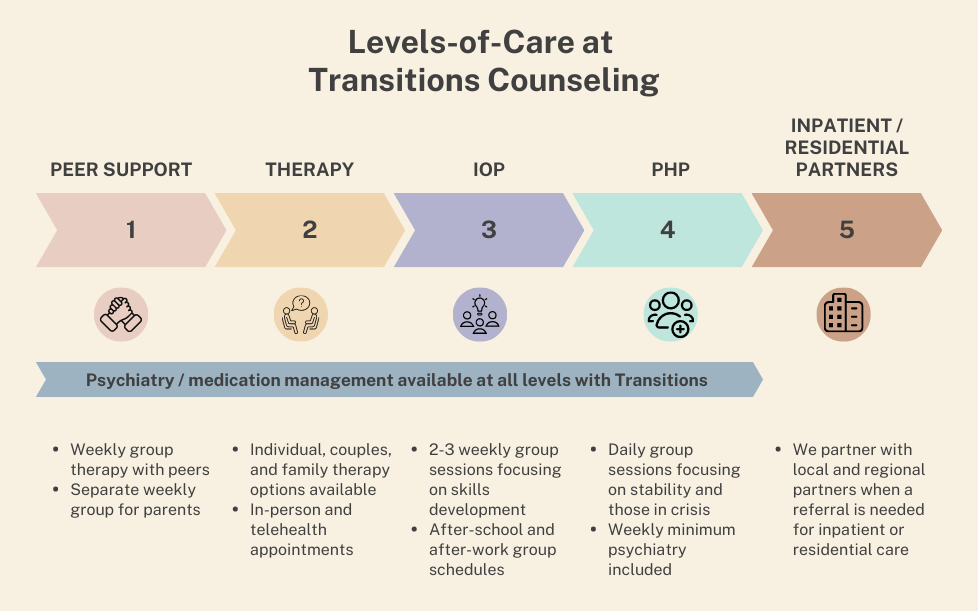
Understanding the mental health levels of care at Transitions
Every teenager’s mental health journey is different, and there isn’t a one-size-fits-all approach to treatment.
Some teens benefit from weekly therapy, while others need the additional structure and support provided by a teen intensive outpatient program or teen partial hospitalization program.
During your teen’s initial assessment, our clinical team will evaluate their symptoms, daily functioning, treatment history, safety needs, and personal goals before recommending the most appropriate level of care. If those needs change over time, your teen can step up to a higher level of care or transition to a lower level as progress is made.
Because Transitions Counseling and Consulting offers a full continuum of outpatient mental health services, families can continue working with the same trusted clinical team throughout treatment whenever possible, creating greater continuity and a more seamless care experience.
Transitions locations offering teen IOP
Transitions Counseling and Consulting offers Teen Intensive Outpatient Programs at locations throughout Arizona and Texas, making it easier for families to access structured adolescent mental health care close to home.
In Arizona, Teen IOP is available at all Transitions locations, including:
Additional Teen IOP programs are also available at select Texas locations.
If you’re unsure which location is the best fit for your family, our team can help you determine the most appropriate program based on your teen’s needs, your preferred location, and scheduling considerations.
We’ll also verify your insurance benefits and outline the next steps to get started.
Frequently Asked Questions
If weekly therapy is no longer providing enough support, your teen’s symptoms are affecting daily life, or a mental health professional has recommended a higher level of care, Teen IOP may be appropriate. Every family begins with a comprehensive assessment so our clinicians can recommend the level of care that best meets your teen’s needs.
No. Teen intensive outpatient programs are designed specifically for adolescents ages 13–17. Teens participate in age-appropriate groups with peers facing similar developmental, emotional, and social challenges.
Getting started begins with a confidential assessment. During this appointment, we’ll learn more about your teen’s symptoms, history, goals, and current level of functioning before recommending the most appropriate treatment plan.
You can request an appointment online or call one of our offices to speak with a member of our team.
Teen IOP provides more support than weekly therapy while allowing adolescents to continue living at home, attending school, and maintaining important family relationships. The program combines evidence-based treatment, peer support, and practical skill development in a structured environment that promotes long-term emotional wellness.
The goal of Teen IOP is to help adolescents improve emotional regulation, strengthen coping skills, develop healthier relationships, increase resilience, and build the confidence needed to manage life challenges more effectively.
Weekly therapy provides ongoing support through regular counseling sessions. Teen IOP offers multiple treatment sessions each week with greater structure and skill development. Teen PHP is a more intensive level of care that provides several hours of treatment each day for adolescents who need additional clinical support before stepping down to IOP.
Most teens participate in Teen IOP for 8-12 weeks, although treatment length varies based on individual progress, clinical recommendations, and personal goals.
It’s completely normal for teens to feel nervous about joining a group. Many adolescents are hesitant during their first few sessions but become more comfortable as they get to know their peers and therapists.
Our clinicians work to create a welcoming, respectful environment where every teen feels supported, and many participants ultimately find that connecting with others facing similar experiences becomes one of the most valuable parts of treatment.
Begin your teen's path toward healing
Taking the first step can feel overwhelming, but you don’t have to navigate it alone.
If your teenager is struggling with anxiety, depression, trauma, emotional regulation, or other mental health challenges, our team is here to help you determine whether a teen intensive outpatient program is the right fit.
We’ll answer your questions, verify insurance benefits, and guide your family through every step of the admissions process.
Together, we can help your teen build the skills, confidence, and support they need to move forward with hope.
